Conference Presentation
MST 1431: The Torah That Took the Long Way Round
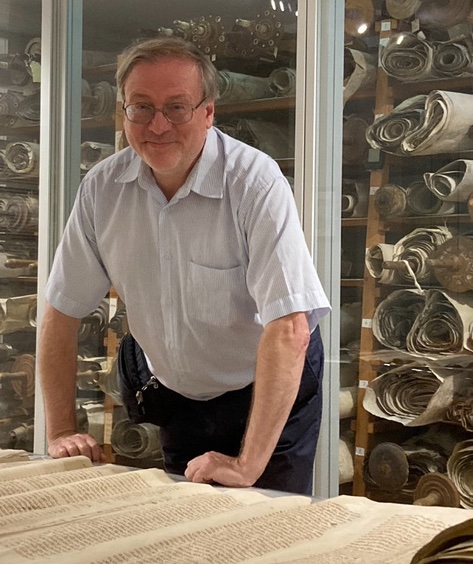
Dr Marc Michaels
Hebrew Manuscript Scholar · Palaeographer · Sofer STa"M
Taylor-Schechter Genizah Research Unit
Cambridge University Library
University of Cambridge
United Kingdom
Presentation Date & Time
Sunday, 8 November 2026
12:00 CET (Serbia time)
Conference
New Discoveries and New Directions in Biblical, Hebrew, and Theological Studies
European Hebrew Journal International Online Conference
Format
Live online via Zoom
Sign Up for Conference Updates by Email
By signing up, you will receive:
- • announcements of newly confirmed international speakers
- • newly announced presentation topics
- • important programme updates and conference news
- • Early Bird reminders before ticket prices increase
- • important registration information and deadlines
- • once a month, a carefully selected digest of important new scientific discoveries and research developments in 2026, especially in Biblical Studies, Hebrew, archaeology, ancient history, Jewish Studies, theology, linguistics, manuscripts, and related fields
Thank you for signing up!
Check your email for updates on new speakers, presentation topics, and conference news.
Something went wrong
Please try again or contact us if the problem persists.
Abstract
When a Jewish community is displaced, and forcibly moved from place to place because of antisemitism, they are not the only things that move. The Torah is very much a portable sanctuary and accompanies them in their exile, providing spiritual guidance and solace, and linking them back to their original place. No more so than the previously ignored MST #1431, that spent several decades as part of a museum exhibit, completely unrecognised. In this talk, Dr Marc Michaels, Sofer STa"M, details the discovery of an important scroll in the Czech Memorial Scrolls Trust collection. Examining the various clues that unlocked its true age, its geographical origin, and significance in the Jewish history of diasporic movement.
About Dr Marc Michaels
Dr Marc Michaels is a scholar of Hebrew manuscripts, Hebrew palaeography, Jewish scribal traditions, and the material history of sacred Hebrew texts. He received his PhD from the Faculty of Asian and Middle Eastern Studies at the University of Cambridge, where he was affiliated with Fitzwilliam College. His doctoral research focused on Sefer Tagin, the ancient scribal manual concerned with distinctive Torah letter forms, scribal ornamentation, and special traditions associated with the writing of Torah scrolls.
Alongside his academic research, Michaels is an experienced practising Sofer STa"M, working in his scribal practice under his Hebrew name Mordechai Pinchas. He has practised the traditional Jewish scribal craft for more than three decades and has worked with Jewish communities in the United Kingdom and internationally. The combination of practical scribal expertise and academic palaeography gives his research a distinctive perspective on the physical production, transmission, dating, identification, and interpretation of Hebrew sacred manuscripts.
Michaels is associated with the Taylor-Schechter Genizah Research Unit at Cambridge University Library as a volunteer scholar. His research there focuses particularly on under-studied STa"M materials and Hebrew manuscript fragments. His work has included the identification and reassessment of Torah scrolls and other manuscripts that had previously been miscatalogued or misdated, as well as research into ancient Hebrew letter forms, mezuzot, Megillot Esther, scribal educational materials, and the historical development of Torah-writing traditions.
He is also associated with the Memorial Scrolls Trust as an approved scribe and has researched historic Torah scrolls and their scribal characteristics. His research on MST 1431 concerns the identification and reassessment of an important Torah scroll in the Czech Scrolls collection. His approach brings together palaeography, scribal practice, manuscript evidence, distinctive Hebrew letter forms, and traditions preserved in works such as Sefer Tagin in order to investigate the age, provenance, transmission, and historical significance of Torah scrolls.
Michaels' scholarship combines close manuscript examination with the history of Hebrew script, palaeographical dating, Masoretic and scribal traditions, and the interpretation of unusual letter forms. His doctoral research argues for significantly earlier origins for traditions preserved in Sefer Tagin and investigates the relationship between distinctive letter forms, visual textual traditions, covenantal interpretation, and Jewish ritual culture.
Academic Formation & Recognition
PhD
Faculty of Asian and Middle Eastern Studies
University of Cambridge
Fitzwilliam College
Research focus: Sefer Tagin, Hebrew manuscripts, scribal traditions, Hebrew palaeography and distinctive Torah letter forms.
MA in Jewish Studies
Leo Baeck College
Traditional Scribal Formation
Five-year apprenticeship with a Sofer, including study of the halakhic traditions governing sofrut.
Senior Scholar Status
University of Cambridge
2022
Awarded for academic performance during his doctoral studies.
Rothschild Foundation Hanadiv Europe Fellowship
2021
Doctoral Research
Sefer Tagin—Olde Face, Slab-Serifs and Semi-Ligatures: Covenantal Warnings and Reassurance. Re-housing the Temple Within the Torah
University of Cambridge
The thesis examines the form, history and function of Sefer Tagin and the distinctive letter forms associated with Torah scribal traditions.
Official record: Cambridge University Repository
DOI: https://doi.org/10.17863/CAM.117276
Research Expertise — Dr Marc Michaels
- • Hebrew Manuscripts
- • Hebrew Palaeography
- • Jewish Scribal Traditions
- • Sofrut
- • Sofer STa"M
- • Sefer Tagin
- • Torah Scrolls
- • Cairo Genizah
- • Taylor-Schechter Genizah Collection
- • Hebrew Script and Letter Forms
- • Masoretic and Scribal Traditions
- • STa"M Manuscripts
- • Ritual Manuscripts
- • Manuscript Dating and Identification
- • Jewish Material Textual Culture
- • Visual Midrash
- • Medieval Hebrew Manuscripts
- • Sacred Text Production
- • History of Hebrew Writing
Selected Publications & Research — Dr Marc Michaels
Sefer Tagin Fragments from the Cairo Genizah: A Critical Edition, Commentary and Reconstruction
Marc Michaels
Cambridge Genizah Studies / Études sur le judaïsme médiéval
Brill, 2020
This major study provides a critical edition, commentary and reconstruction of Sefer Tagin fragments from the Cairo Genizah.
"The Qôf Dĕḇûqâ: The Origins and Original Meaning of the Joined Qôf"
Marc Michaels
Comparative Oriental Manuscript Studies Bulletin 11(2), 2025, pp. 243–264.
"Getting the Hump: the Letter Ḥet in Holy Writings"
Marc Michaels
Review of Rabbinic Judaism 28(2), 2025, pp. 127–163.
"Cambridge University Library, T-S A36.18—a Fragment from the Oldest Known Megillat ʾEster"
Marc Michaels
Comparative Oriental Manuscript Studies Bulletin 10(1–2), 2024, pp. 33–48.
This research investigates a Genizah fragment that Michaels identifies as potentially the oldest surviving ritual Megillat Esther fragment.
"What's My Line? Reconstructing CUL T-S NS 3.21+"
Marc Michaels
Taylor-Schechter Genizah Research Unit / Cambridge University Library, 2026.
This research reconstructs part of CUL T-S NS 3.21+, identified by the Genizah Research Unit as likely the oldest Torah in the Cairo Genizah and one of the oldest manuscripts in the collection.
Academic Profile
Cambridge University Library — Official Profile
ORCID
Academic Publications CV
Keywords
The presentation keywords will be announced soon.
Suggested Citation
Michaels, Marc. "MST 1431: The Torah That Took the Long Way Round." Invited presentation at New Discoveries and New Directions in Biblical, Hebrew, and Theological Studies, European Hebrew Journal International Online Conference, 8 November 2026.
Attend This Presentation
Register for the European Hebrew Journal International Online Conference to attend the live presentation and receive twelve months of access to the complete conference recording library.