Joint Panel Discussion
Can Artificial Intelligence Become a Spiritual Authority?
A Jewish–Christian–Muslim Panel Discussion
Date & Time
8 November 2026
10:00 CET | Online via Zoom
Format
Live Panel Discussion
Conference
New Discoveries and New Directions in Biblical, Hebrew, and Theological Studies
European Hebrew Journal International Online Conference
Sign Up for Conference Updates by Email
By signing up, you will receive:
- • announcements of newly confirmed international speakers
- • newly announced presentation topics
- • important programme updates and conference news
- • Late Registration deadline reminders
- • important registration information and deadlines
- • once a month, a carefully selected digest of important new scientific discoveries and research developments in 2026, especially in Biblical Studies, Hebrew, archaeology, ancient history, Jewish Studies, theology, linguistics, manuscripts, and related fields
Thank you for signing up!
Check your email for updates on new speakers, presentation topics, and conference news.
Something went wrong
Please try again or contact us if the problem persists.
This panel brings together Jewish, Christian and Muslim scholars and practitioners who have previously engaged publicly with questions concerning artificial intelligence, religion and ethics. Their discussion will examine whether increasingly sophisticated AI systems can or should acquire forms of authority traditionally associated with religious teachers, institutions, communities and sacred traditions.
Panel Participants

Rev. Dr. Chris Goswami
Christian Perspective
Founder, AI Christian Partnership, United Kingdom
Rev. Dr. Chris Goswami has approximately three decades of experience in high-technology organizations, including leadership roles in Silicon Valley. He is Founder of the AI Christian Partnership, an initiative established to promote AI literacy and help Christians navigate the opportunities and challenges presented by artificial intelligence.
He holds degrees in Theology and Electronic Engineering, as well as an MSc and PhD in Telecommunications, and is a Chartered Engineer. He is also a Baptist minister, a chaplain at Manchester Airport, and a writer on Christianity, technology and artificial intelligence.
Through his writing and public engagement, he explores how Christian theology and practice can respond responsibly to rapidly developing technologies.

Rabbi Dr. Harris Bor
Jewish Perspective
Twenty Essex / London School of Jewish Studies / AI and Faith, United Kingdom
Rabbi Dr. Harris Bor is a barrister practising international arbitration and commercial and company litigation, including technology-related disputes, from Twenty Essex in London. He is also Research Fellow and Lecturer at the London School of Jewish Studies, a rabbi, and Non-Executive Chair of AI and Faith.
He is a Commissioner with the AI Faith & Civil Society Commission and has spoken widely on law, religion, technology and artificial intelligence. He is the author of Staying Human: A Jewish Theology for the Age of Artificial Intelligence (2021).
Harris holds an LLM in International and Comparative Dispute Resolution from Queen Mary University of London and a PhD from the University of Cambridge.
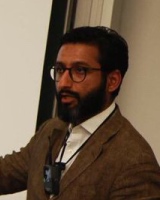
Dr. Yaqub Chaudhary
Muslim Perspective
Leverhulme Centre for the Future of Intelligence, Institute for Technology and Humanity, University of Cambridge, United Kingdom
Dr. Yaqub Chaudhary is a scholar working at the intersection of artificial intelligence, cognitive science, neuroscience and Islamic thought. He has been associated with the Leverhulme Centre for the Future of Intelligence, part of the Institute for Technology and Humanity at the University of Cambridge.
His research examines artificial intelligence in relation to Islamic conceptions of the mind, intelligence, human reasoning, cognition, knowledge, perception and consciousness. He holds a Master of Engineering degree and a PhD in Physics from Imperial College London.
His publications and public scholarship address Islamic digital ethics, artificial intelligence and the ethical implications of emerging technologies from an Islamic perspective.
Panel Description
This joint Jewish–Christian–Muslim panel examines whether artificial intelligence can become, or already function as, a form of spiritual or religious authority.
As AI systems are increasingly used to answer moral, theological, scriptural and existential questions, the panel asks what happens when individuals begin to treat artificial intelligence not merely as a technological tool, but as a source of guidance, wisdom, interpretation or even spiritual counsel.
Drawing on Jewish, Christian and Muslim perspectives, the discussion will examine the theological, ethical, communal, legal and pastoral limits of artificial authority.
Key Questions for Discussion
- Can an AI system legitimately exercise any form of spiritual or religious authority?
- What distinguishes information from wisdom?
- Can artificial intelligence interpret sacred texts responsibly?
- What happens when believers increasingly seek moral or spiritual guidance from AI rather than religious communities or human teachers?
- How do Judaism, Christianity and Islam understand authority, revelation, tradition and human responsibility in relation to artificial intelligence?
- What theological and ethical limits should religious communities place on the use of AI?
- Can AI assist religious communities without becoming a substitute for human relationships, spiritual formation and religious authority?
The purpose of the panel is not to produce a single shared Abrahamic position, but to place three distinct religious traditions in direct scholarly conversation about one of the most important emerging questions concerning religion and technology.