Over 400 Coins Found at El-Araj in October 2026: Aviam Reveals New Evidence in the Search for Biblical Bethsaida
A preliminary announcement from the EHJ conference adds a new reported coin total to the archaeological discussion of El-Araj and Bethsaida-Julias.
More than 400 ancient coins were discovered during the October 2026 excavations at El-Araj, according to Professor Mordechai Aviam, who disclosed the figure during a special joint presentation with Professor R. Steven Notley at the European Hebrew Journal International Online Conference on 7 November 2026.
The announcement formed part of a special extended joint presentation by Professor Mordechai Aviam and Professor R. Steven Notley, two leading scholars associated with the El-Araj Excavation Project. While Aviam presented the latest archaeological evidence and material discoveries from the excavation, Notley, Professor and Dean of Religious Studies at Pillar College in the United States and Academic Director of the project, contributed the historical-geographical framework essential to evaluating the proposed identification of El-Araj with ancient Bethsaida-Julias. Their combined perspectives brought archaeological evidence, ancient literary testimony, and historical geography into a single scholarly discussion.
The joint session, titled “El-Araj / Bethsaida: New Discoveries from the 2026 Excavation Season” with the subtitle “Latest Archaeological Evidence, Historical Geography, and the Continuing Search for Bethsaida-Julias,” was scheduled for Saturday, 7 November 2026, at 23:00 CET as a special extended presentation of approximately 90–120 minutes. See the official joint presentation page.
Professor Aviam is Director of the Kinneret Institute for Galilean Archaeology at Kinneret Academic College, Israel, and contributes expertise in Galilean archaeology, excavation results, material culture, and Roman and Byzantine contexts. Professor Notley, of Pillar College in Newark, New Jersey, serves as Academic Director of the El-Araj Excavation Project and brings expertise in historical geography, ancient sources, and the historical setting of the Gospels. Their roles are complementary; the reported October coin total remains specifically attributed to Aviam.
The announcement introduces significant new numismatic information from the tenth excavation season at the site, located near the northeastern shore of the Sea of Galilee and investigated as a possible location of ancient Bethsaida-Julias.
Earlier public reports from the summer 2026 excavation campaign documented more than 150 coins, together with Herodian oil lamps, Jewish stone vessels, Roman architecture, and fishing-related artifacts. Aviam's newly reported figure of more than 400 coins must be distinguished from those earlier published summer figures. The precise relationship between the summer finds and the October total should not be assumed without clarification from the excavation team.
October 2026: Aviam Reports More Than 400 Coins
During the EHJ conference presentation on 7 November, Professor Mordechai Aviam reported that more than 400 coins had been discovered during the October 2026 excavations at El-Araj. This information represents an important development beyond the results described in the project's earlier summer excavation reports.
Coins recovered from securely documented archaeological contexts can contribute to understanding the chronology of settlement, patterns of economic activity, and the historical development of a site. However, the significance of individual discoveries depends on numismatic identification, stratigraphy, archaeological context, and subsequent scholarly analysis.
The reported discovery should therefore be understood as a significant preliminary archaeological announcement, not as definitive proof that El-Araj has been identified as ancient Bethsaida. The conference report does not, by itself, establish the dates, denominations, rulers, mints, or depositional circumstances of the coins. No single hoard or uniform date range should be inferred from the reported total.
A New Announcement, Distinct from the Summer Results
The earlier summer-season figure and Aviam's October announcement describe separate reported stages of work. Public summaries of the summer campaign had already noted more than 150 coins alongside other finds. The October total was reported later, during the joint conference session. Without a clarified project accounting, the two totals cannot responsibly be combined: it is not yet clear whether the October figure is a distinct count, a cumulative season total, or calculated under another reporting convention.
This distinction matters for readers and researchers. Archaeological totals become meaningful when the objects have been documented, identified, and related to their find contexts. Until the excavation team provides additional detail, this article preserves the wording and attribution of the announcement rather than supplying an interpretation beyond the available information.
Why Coins Matter to the Archaeology of El-Araj
Numismatic evidence can help archaeologists investigate when activity took place at a site and how its occupation changed. A coin's archaeological value, however, depends on more than its presence. Researchers consider its identification alongside the layer and locus in which it was recovered, its association with other material, and whether the context has been disturbed or reused.
When those details are available, coin assemblages can contribute to a site's chronology and illuminate aspects of exchange and regional economic life. They must still be interpreted with the full archaeological record. A large number alone cannot identify a settlement, establish the date of every structure, or demonstrate a specific historical event.
At El-Araj, the reported October count is therefore best treated as a notable new piece of evidence awaiting fuller documentation. Publication of catalogued coins and contextual data would allow scholars to assess the assemblage and compare it with other evidence from the site and the wider Galilee.
An aggregate number is a starting point for inquiry, not a substitute for a find catalogue. Until the excavation team clarifies the count and its contexts, readers should keep the announcement distinct from conclusions about the settlement's economy, chronology, or identity.
R. Steven Notley: Historical Geography and the Search for Ancient Bethsaida
Professor R. Steven Notley's contribution to the El-Araj project provides an essential historical-geographical dimension to the interpretation of the archaeological evidence. As Academic Director of the excavations and Professor and Dean of Religious Studies at Pillar College in Newark, New Jersey, Notley approaches the question of Bethsaida's location through the critical examination of ancient literary sources, geographical descriptions, and the historical landscape of the Sea of Galilee.
Bethsaida-Julias occupies an important place in the study of ancient Galilee because of its connections with the New Testament, Roman-period regional history, and the geographical accounts of ancient authors. The settlement is associated in the Gospel traditions with the apostles Peter, Andrew, and Philip, while historical references to Bethsaida and Julias raise questions concerning settlement development, political status, and geographical location.
Notley's research places these references in dialogue with archaeological discoveries. The identification of a settlement described in ancient sources cannot rest solely upon the presence of Roman-period buildings or objects. It requires careful evaluation of geographical relationships, textual descriptions, settlement chronology, and the changing physical environment surrounding the northern Sea of Galilee.
The historical geography of the region presents particular challenges. The relationship between ancient shorelines, river courses, settlement locations, and modern topography must be critically reconstructed rather than assumed to have remained unchanged since antiquity.
Within this framework, the archaeological investigations at El-Araj provide evidence that can be compared with the expectations derived from historical sources. Notley's contribution is therefore not secondary to the archaeological discussion: it supplies a complementary methodological framework through which the material discoveries can be assessed.
Such an approach also highlights the limits of individual categories of evidence. Neither textual identification nor archaeological similarity independently establishes the location of ancient Bethsaida-Julias. The strongest historical arguments emerge when independent forms of evidence converge, while disagreements and alternative identifications remain open to scholarly evaluation.
Bethsaida-Julias: An Identification Still Under Discussion
El-Araj is investigated as a candidate for ancient Bethsaida-Julias, the settlement associated in ancient sources with the northern Sea of Galilee. The identification is a sustained scholarly question involving historical geography, textual evidence, topography, chronology, and archaeological remains. The coin announcement adds to the discussion, but it does not resolve it.
Professor R. Steven Notley contributes the historical-geographical perspective in the joint presentation, while Professor Mordechai Aviam presents archaeological research connected with the excavation. Their complementary approaches place the reported finds within a broader inquiry: how should the material evidence at El-Araj be compared with ancient descriptions of Bethsaida and Julias?
Where Professor Aviam's investigation focuses upon stratigraphically documented material remains, architecture, coins, and other evidence recovered during excavation, Professor Notley's historical-geographical approach investigates the relationship between the ancient descriptions of Bethsaida-Julias and the physical landscape in which the settlement developed.
Taken together, these approaches help clarify why the identification of El-Araj remains a multidisciplinary research question rather than a conclusion that can be established through one spectacular discovery. The reported October coin total adds potentially valuable archaeological information, but its historical implications depend upon proper documentation, dating, and contextual analysis.
That inquiry requires attention to the changing landscape around the Sea of Galilee, the location and development of settlements, and the relationship between written sources and excavated contexts. Competing identifications and interpretations remain part of the scholarly conversation, and new finds should be assessed alongside—not in place of—the accumulated evidence.
From Preliminary Report to Scholarly Assessment
Aviam's conference announcement is newsworthy because it brings a reported October excavation result into public discussion. It should not be confused with a peer-reviewed publication: the figure has not been presented here as a published numismatic catalogue or independently verified total. Nor does this report claim access to a recording or a transcript beyond the information supplied for the announcement.
For now, the careful conclusion is both clear and limited: Professor Aviam reported more than 400 coins from October 2026 excavations at El-Araj during the EHJ conference on 7 November. The announcement adds a significant preliminary data point to ongoing work at the site, while the relationship to the earlier summer count and the implications for Bethsaida-Julias remain open questions.
The Continuing Search for Bethsaida
The 7 November session formed part of the European Hebrew Journal International Online Conference, “New Discoveries and New Directions in Biblical, Hebrew, and Theological Studies.” The presentation by Aviam and Notley offered an opportunity to hear archaeological and geographical perspectives together. The October coin report now gives the continuing debate a new, carefully attributable development—one that merits further documentation before stronger conclusions are drawn.
The special extended session demonstrated the scholarly value of combining Professor Mordechai Aviam's archaeological investigations with Professor R. Steven Notley's historical-geographical research. Their joint presentation offered conference participants two complementary perspectives on the evidence from El-Araj: the excavated material record and the ancient textual and geographical framework within which the identification of Bethsaida-Julias must be evaluated. The reported October 2026 coin discoveries add a significant new element to this continuing research, while further documentation and critical assessment remain essential.
Readers can consult the official Aviam and Notley presentation page and the earlier report on the 2026 summer excavation discoveries for related background.
Watch Professors Mordechai Aviam and R. Steven Notley — EHJ Conference 2026
Recommended Conference Articles
New 2026 Discoveries at El-Araj Add Fresh Evidence to the Search for Ancient Bethsaida
Earlier summer-season findings at El-Araj included coins, lamps, stone vessels, and evidence relevant to the Bethsaida-Julias discussion.
Read Article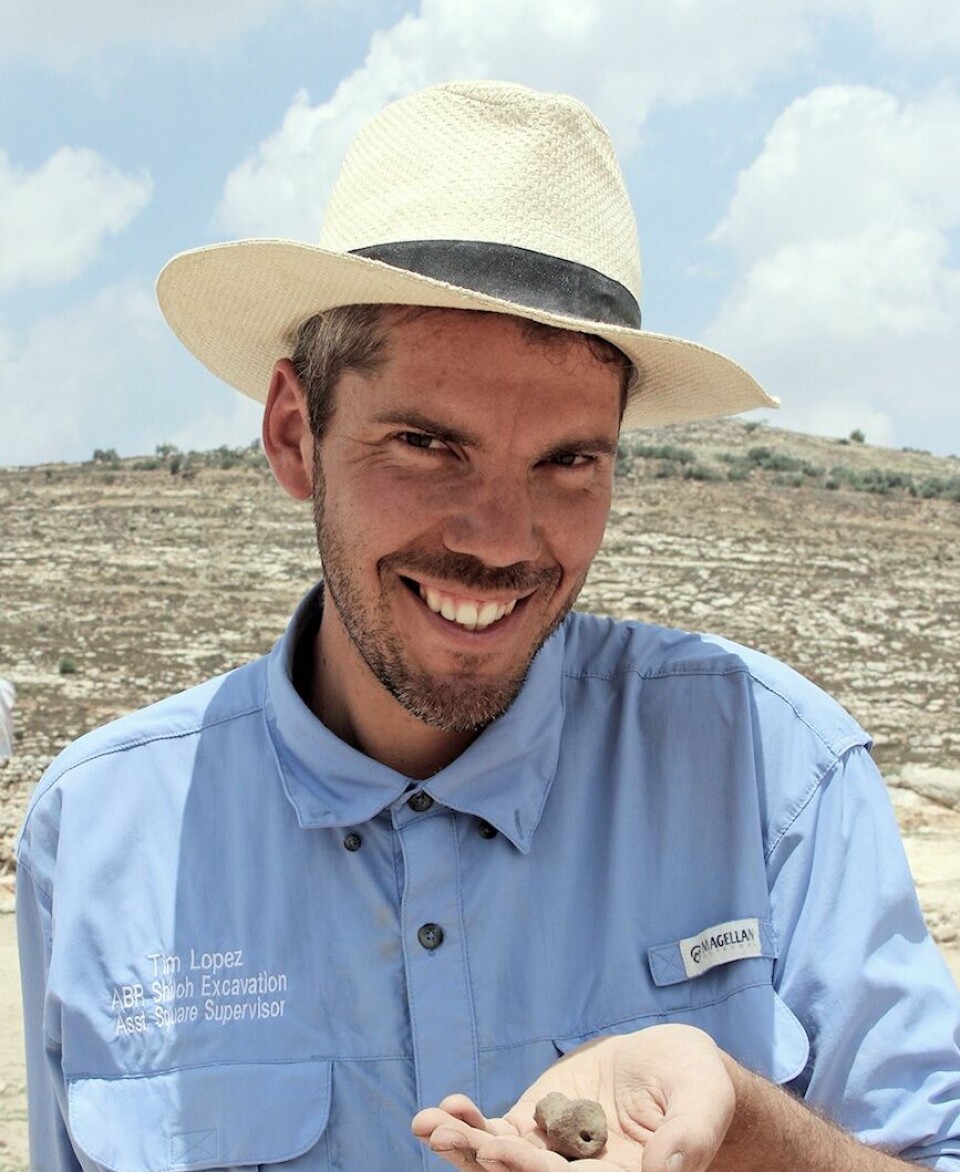
Tim Lopez Presents New Archaeological Evidence from Biblical Shiloh at EHJ 2026
A conference report on recent Shiloh excavation evidence, monumental architecture, and ongoing interpretation.
Read Article
Photo: Ian Scott, CC BY-SA 2.0.
EHJ 2026 Opens with Dr. Daniel Vainstub's Lecture on a Canaanite Inscription from Lachish
A report on epigraphic research and archaeological context at ancient Lachish.
Read ArticleAccess the Complete Conference Recording
The European Hebrew Journal International Online Conference, “New Discoveries and New Directions in Biblical, Hebrew, and Theological Studies,” takes place from 6 to 10 November 2026 and brings together more than 75 international scholars.
Organized by the Institute for Hebrew Language and Literature in Belgrade, under the leadership of Prof. Dr. Željko Stanojević, the event promotes scholarly cooperation and supports the European Hebrew Journal.
Registration includes access to remaining live presentations and interactive Q&A sessions, together with 12 months of access to recordings of all five conference days, including presentations already delivered.
Conference revenue supports the European Hebrew Journal's Diamond Open Access publishing model, without publication fees for authors or subscription fees for readers.